River Implementation
Collecting Datasets from the River
This phase represents the transition from controlled model development to real-world deployment, where AquaTRAC AI operates directly within the river environment.
The primary implementation site is a strategically selected fish passage at a dam within the Yodo River Basin, enabling consistent and concentrated observation of aquatic movement. This controlled yet natural setting provides ideal conditions for validating AI performance under real ecological dynamics.
Field Data Acquisition Framework
-
Continuous Video Monitoring (24/7)
Installed camera systems capture uninterrupted high-definition video streams, ensuring complete temporal coverage of aquatic activity. -
Standardized Observation Point
The fish passage structure naturally channels aquatic species through a defined corridor, allowing:- Reliable detection and counting
- Reduced observational uncertainty
- Consistent data collection across time
-
Integrated Data Flow Architecture
- Video data is transmitted to a central processing server
- Processed outputs are simultaneously visualized through a local monitoring dashboard
- Supports both real-time analysis and historical data storage
This setup establishes a continuous, high-resolution ecological data stream, forming the backbone of AI-driven monitoring.
Real-Time Monitoring and AI Predictions
The full capability of AquaTRAC AI is realized through its real-time inference system, where live video streams are processed directly by edge-computing AI units.
Real-Time Dashboard (In-Video Analytics)
Each video frame is analyzed instantly, providing dynamic and continuously updated metrics:
-
Frame Count
Tracks the progression of processed frames (e.g., Frame 2933), ensuring precise temporal indexing. -
Tracked Objects
Displays the number of detected entities within each frame (e.g., 1 fish detected). -
Cumulative Count
Maintains a running total of detected individuals, enabling accurate monitoring of fish passage over time.
AI-Based Detection and Identification
-
Simultaneous Detection and Classification
The YOLOv8 model identifies species in real time and overlays:- Bounding boxes around detected objects
- Confidence scores indicating prediction reliability
-
High-Speed Processing
The system processes multiple frames per second, enabling near-instantaneous ecological insights. -
Autonomous Operation
Fully automated detection and tracking eliminate the need for manual observation, significantly improving efficiency and scalability.
Live Demonstration
A real-world implementation of the AquaTRAC AI system can be observed in the following demonstration:
This deployment demonstrates how AquaTRAC AI transforms river monitoring into a continuous, intelligent, and data-driven process, enabling real-time understanding of aquatic ecosystems and supporting informed environmental management decisions.
Video Analysis Pipeline
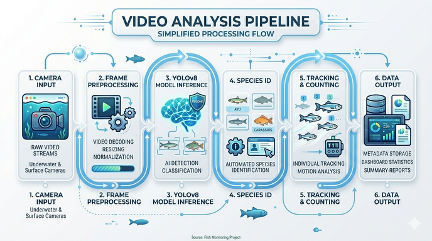
The AquaTRAC AI system operates through a streamlined and efficient video analysis pipeline, transforming raw video streams into actionable ecological intelligence. This pipeline ensures continuous, real-time processing while maintaining high accuracy and scalability.
End-to-End Processing Workflow
-
Camera Input
High-definition video streams are continuously captured from underwater and surface camera systems, providing real-time observational data of aquatic environments. -
Frame Preprocessing
Incoming video is processed to ensure optimal input quality for AI inference, including:- Video decoding and frame extraction
- Image resizing and normalization
- Enhancement for low-light and turbidity conditions
-
YOLOv8 Model Inference
The preprocessed frames are passed through the YOLOv8 deep learning model, which performs:- Object detection
- Species classification
- Confidence scoring for each detected object
-
Species Identification
Detected objects are automatically classified into predefined categories (e.g., Ayu, Carassius, and other target species), enabling species-level ecological monitoring. -
Tracking and Counting
Advanced tracking algorithms follow individual fish across consecutive frames, allowing:- Unique object identification
- Movement trajectory analysis
- Accurate cumulative counting without duplication
-
Data Output and Visualization
Processed data is structured and stored for further analysis and decision-making:- Metadata generation (time, species, size, movement)
- Real-time dashboard updates
- Automated reporting and long-term data archiving
System Significance
This pipeline enables AquaTRAC AI to function as a fully automated, real-time ecological intelligence system, capable of:
- Converting raw video into structured environmental data
- Delivering continuous monitoring without human intervention
- Supporting scientific analysis, policy decisions, and ecosystem management