
Field & Datasets
Yodo River Basin: Our Study Site
The Yodo River Basin is one of Japan’s most significant and complex river systems, serving as a critical lifeline for the Kansai region, including Kyoto, Osaka, and surrounding urban and natural environments. Originating from Lake Biwa, Japan’s largest freshwater lake, the river system flows through diverse landscapes before discharging into Osaka Bay.
This basin represents a unique convergence of natural ecosystems, urban infrastructure, and hydraulic engineering, making it an ideal living laboratory for advanced environmental monitoring.
Why the Yodo River Basin?
- Ecological Diversity
The basin supports a wide range of aquatic species, including migratory fish, making it highly suitable for biodiversity monitoring and behavioral analysis. - Hydrological Complexity
The system integrates multiple tributaries, regulated flows, and dam-controlled sections, providing varied hydraulic conditions for testing AI-based monitoring systems. - Urban–Natural Interface
The river passes through densely populated urban areas as well as natural and semi-natural environments, allowing evaluation of human impacts on aquatic ecosystems. - Strategic National Importance
As a major water resource for millions of people, the Yodo River Basin plays a vital role in water supply, flood control, and environmental sustainability in Japan.
Role in AquaTRAC AI
Within the AquaTRAC AI Project, the Yodo River Basin serves as a pilot and validation platform where advanced monitoring technologies are deployed under real-world conditions. The diversity of river environments—ranging from upstream natural reaches to downstream urban channels—enables comprehensive system testing and optimization.
This study site provides the foundation for developing a scalable and transferable monitoring framework, ensuring that the technologies and methodologies established here can be adapted to river systems worldwide.
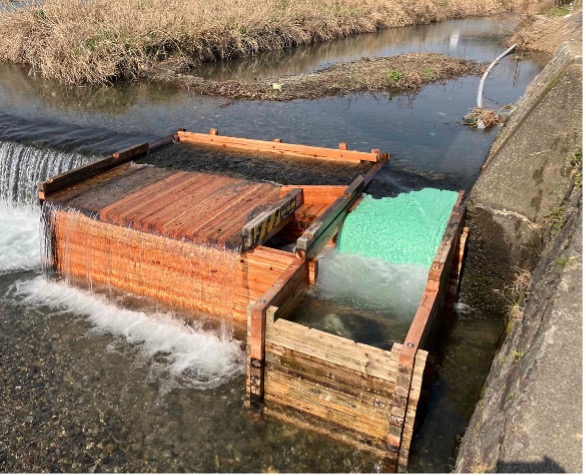
Fish passway
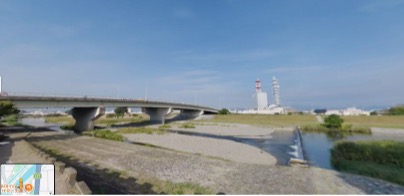
Kamo river site for the fish pass way.
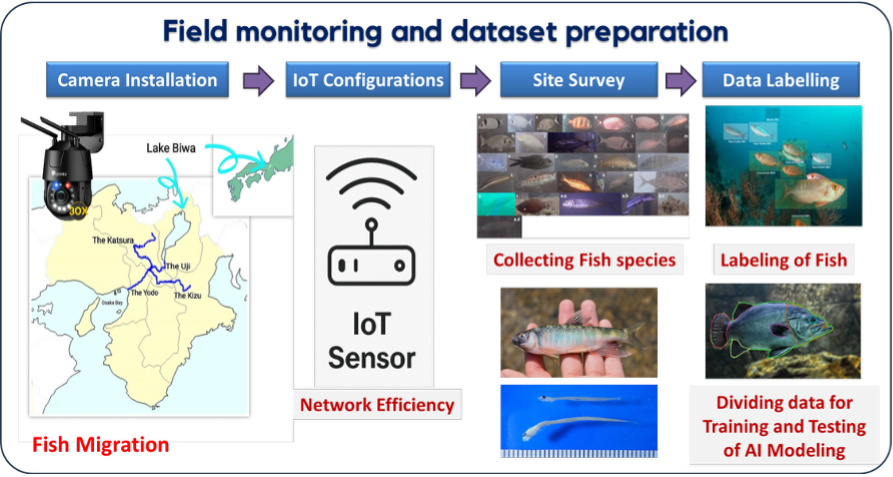
Camera System Preparation & Installation
The successful deployment of AquaTRAC AI relies on a robust, field-ready sensing infrastructure designed to operate continuously under dynamic river conditions. To achieve this, we developed customized camera systems built on modular, cost-efficient hardware (Raspberry Pi-based platforms) capable of high-definition video acquisition in both underwater and surface environments.
System Design and Preparation
- Custom Hardware Integration
Each unit combines high-resolution cameras, embedded computing (Raspberry Pi), waterproof housings, and stable power supply systems to ensure reliable long-term operation. -
Laboratory Testing and Validation
Extensive pre-deployment testing was conducted to validate:- Waterproof and pressure-resistant camera enclosures
- Power management systems for continuous operation
- Data transmission protocols via a centralized Gateway Server
- System resilience under varying light and turbidity conditions
- Remote Connectivity Architecture
A secure data pipeline was established to enable real-time or near-real-time transmission of video streams from field units to the processing server.
Field Deployment and Installation
- Strategic Site Selection
Camera systems were installed at key monitoring locations across the Yodo River Basin, including fish passages, where biological activity is concentrated and highly informative. -
Operational Deployment
Field teams successfully deployed and calibrated the systems, ensuring optimal positioning for:- Clear field of view
- Minimal disturbance to aquatic habitats
- Maximum detection accuracy
- Ongoing Data Acquisition
Continuous video collection is now underway across multiple sites, forming the foundation for AI-based detection, tracking, and analysis. - Project Milestone
A key deployment phase—Fishway and camera installation scheduled for 22 March—marks a critical step in transitioning from system preparation to full operational monitoring.
This integrated hardware and deployment strategy ensures that AquaTRAC AI operates as a scalable, resilient, and real-time environmental sensing network, capable of supporting advanced ecological intelligence across diverse river conditions.
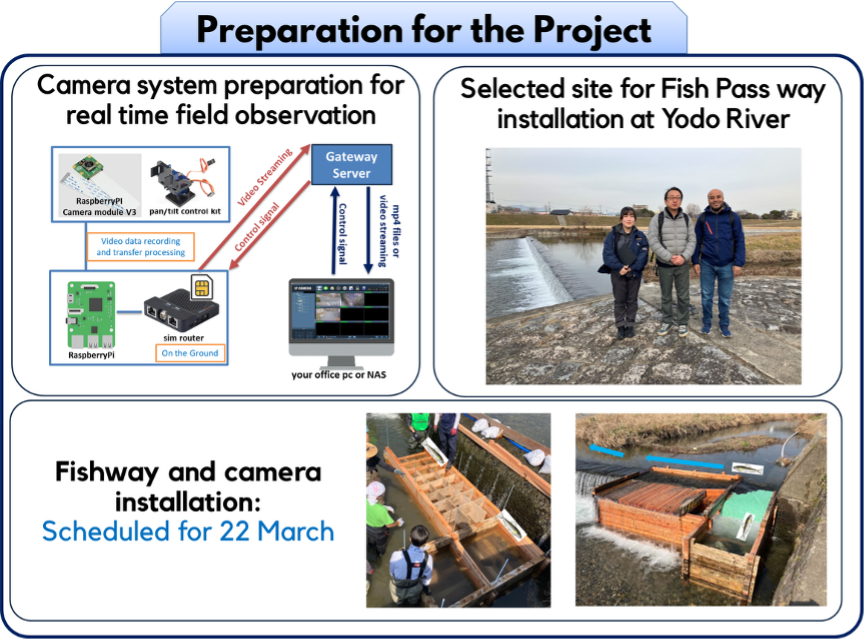
Camera and fish way installation
Dataset Acquisition and Labeling
The development of a high-performance AI model depends fundamentally on the availability of high-quality, diverse, and accurately labeled datasets. AquaTRAC AI adopts a rigorous data acquisition and annotation strategy to ensure reliability, generalization, and scientific validity.
Data Acquisition Strategy
-
Historical Monitoring Integration
Long-term ecological datasets, including Ayu fish migration records (2011–2024) provided by Prof. Takemon, are incorporated to:- Understand species composition and seasonal dynamics
- Inform dataset balancing and sampling strategies
- Support validation of AI-derived outputs against observed trends
-
Direct Video-Based Observation
Continuous video streams from deployed camera systems serve as the primary data source. From these recordings:- Representative image frames are systematically extracted
- Key ecological scenarios are captured, including fish passage events and varying environmental conditions
Ensuring Dataset Diversity
To achieve robust model performance under real-world conditions, the dataset is curated to include:
- Lighting Variability: Daytime, nighttime, and low-light environments
- Water Conditions: Clear water, turbidity, and suspended sediment scenarios
- Biological Density: Sparse to high-density fish populations
- Environmental Contexts: Natural channels, urban sections, and fishways
This diversity ensures that the trained model remains adaptive and resilient across different operational settings.
Labeling and Annotation Process
-
Manual Annotation and Verification
Each image is carefully labeled by trained personnel, including:- Bounding boxes for object localization
- Species identification (e.g., Ayu and other target species)
- Size classification (e.g., small, medium, large)
-
Quality Assurance Protocol
A multi-stage verification process is implemented to:- Minimize labeling errors
- Ensure consistency across annotators
- Maintain high annotation accuracy standards
-
Training-Ready Dataset Generation
Final datasets are structured and formatted for deep learning pipelines (e.g., YOLO-based frameworks), enabling efficient training, validation, and testing.
Through this comprehensive dataset development process, AquaTRAC AI establishes a reliable foundation for accurate detection, classification, and behavioral analysis, ensuring that the AI system performs effectively in complex and dynamic aquatic environments.