
Real-Time Monitoring of Biodiversity in the Yodo River Basin, Japan.
About AquaTRAC AI
The AquaTRAC AI Project (AI-Based Real-Time Monitoring of Aquatic Biodiversity in the Yodo River Basin, Japan) is a pioneering initiative dedicated to advancing the sustainable monitoring of aquatic ecosystems through cutting-edge artificial intelligence.
Our mission is to redefine how river biodiversity is observed and managed—transitioning from fragmented, labor-intensive field practices to a scalable, data-driven, and real-time monitoring system. By integrating AI, computer vision, and intelligent sensing technologies, AquaTRAC AI enables continuous, high-resolution insights into aquatic life and ecosystem dynamics.
The Yodo River Basin serves as a strategic pilot environment, where advanced monitoring frameworks are developed, validated, and optimized under real-world conditions. This foundation supports the creation of a robust, transferable technological platform capable of deployment across diverse river systems globally.
Through AquaTRAC AI, we aim to support environmental sustainability, enhance ecosystem resilience, and provide decision-makers with actionable intelligence to protect and restore vital freshwater resources.
Problem Statement: Limitations of Current Monitoring Approaches
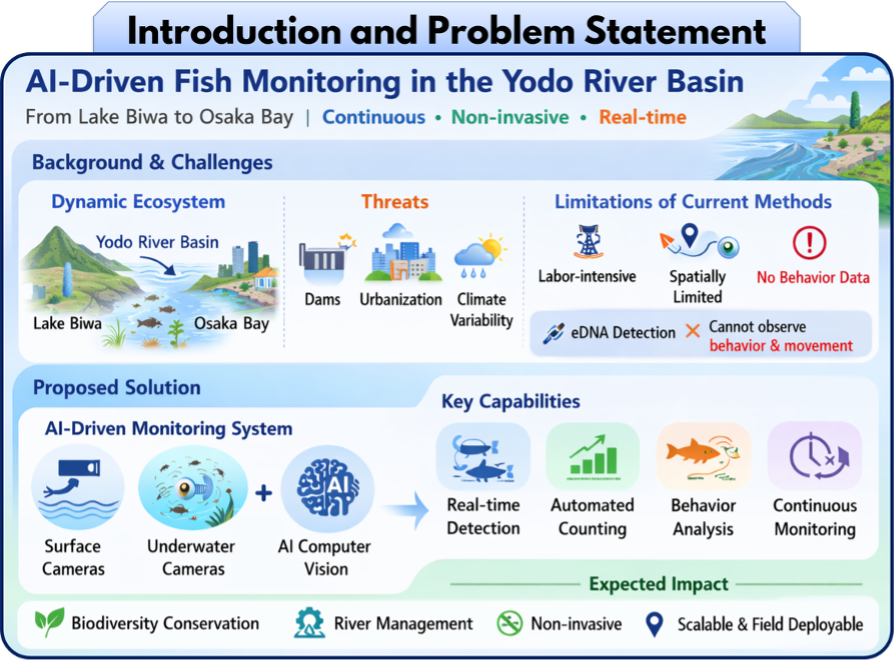
River ecosystems worldwide are facing increasing environmental stress due to climate variability, urbanization, and infrastructure development. However, existing monitoring approaches remain fundamentally inadequate for capturing the complexity and dynamics of aquatic biodiversity at scale.
Current methodologies are constrained by several critical limitations:
- Labor-Intensive Operations
Conventional surveys rely heavily on human field teams, making continuous and large-scale monitoring economically and logistically impractical. - Limited Spatial Coverage
Observations are often restricted to specific locations, resulting in fragmented datasets and significant spatial gaps across river systems. - Temporal Discontinuity
Traditional monitoring provides only periodic “snapshots,” failing to capture time-sensitive ecological processes such as migration cycles, spawning events, or rapid responses to environmental disturbances. - Invasive Sampling Techniques
Many physical monitoring methods disrupt habitats and may stress or harm aquatic species, compromising both ecological integrity and data reliability. - Lack of Behavioral and Morphological Insights
While techniques such as environmental DNA (eDNA) can detect species presence, they do not provide information on individual size, condition, behavior, or movement dynamics.
These limitations highlight the urgent need for a non-invasive, continuous, and intelligence-driven monitoring framework.
Why AquaTRAC AI?
AquaTRAC AI is designed to address these challenges through the integration of advanced sensing technologies and state-of-the-art artificial intelligence.
Rather than relying on passive and intermittent observation, the project establishes an active, real-time ecological intelligence system capable of:
- Simultaneous identification of multiple aquatic species
- Accurate counting and size estimation of individuals
- Continuous tracking of movement and migration patterns
- Fully autonomous operation (24/7), adaptable to varying environmental and lighting conditions
By transforming raw observational data into actionable insights, AquaTRAC AI enables a new paradigm in aquatic ecosystem monitoring.
The Power of AI & Computer Vision in Aquatic Monitoring
The integration of artificial intelligence—specifically computer vision technologies such as the YOLOv8 object detection framework—enables unprecedented capabilities in aquatic environments.
Key innovations include:
- Real-Time Detection and Classification
Processing live video streams to identify and classify species instantly as they move through monitored areas. - Automated Counting and Data Scaling
Eliminating human error while generating continuous, high-volume datasets suitable for advanced statistical and ecological analysis. - Behavioral Intelligence
Capturing detailed movement trajectories, schooling patterns, and responses to environmental changes, enabling deeper ecological understanding. - Continuous Temporal Monitoring
Recording ecosystem dynamics without interruption, ensuring that critical events—such as migration peaks or disturbance impacts—are never missed.
Together, these capabilities establish the foundation for the first truly continuous and high-resolution biodiversity dataset for the Yodo River Basin.
Objectives and Methodology Overview
AquaTRAC AI follows a structured, phased methodology to design, develop, and deploy a scalable intelligent monitoring system:
- Objective 1: Smart Sensing System Development
Design and deploy a network of robust, high-resolution surface and underwater camera systems to ensure comprehensive spatial coverage across diverse river environments. - Objective 2: Deep Learning Model Optimization
Customize and train advanced AI models (YOLOv8) to accurately detect, classify, and analyze fish species specific to the Yodo River ecosystem. - Objective 3: System-Wide Deployment and Scaling
Expand the monitoring infrastructure across multiple river segments, including urban reaches, natural channels, and dam-influenced zones. - Objective 4: Integrated Environmental Impact Analysis
Combine biological observations with environmental datasets (e.g., water quality, flow dynamics, and climate variables) to assess ecosystem responses and human impacts in real time.
This integrated approach ensures both scientific rigor and operational scalability, enabling deployment beyond the pilot region.
Principal Investigator
The AquaTRAC AI Project is led by Dr. Mohamed Saber, Associate Professor at the Disaster Prevention Research Institute (DPRI), Kyoto University.
Dr. Saber specializes in environmental systems, hydrology, and AI-driven modeling for water-related challenges. His work focuses on integrating advanced computational methods with real-world environmental applications, particularly in flood risk management, ecosystem monitoring, and climate resilience. Under his leadership, AquaTRAC AI brings together expertise in artificial intelligence, ecology, and river engineering, fostering a multidisciplinary approach to next-generation environmental monitoring.
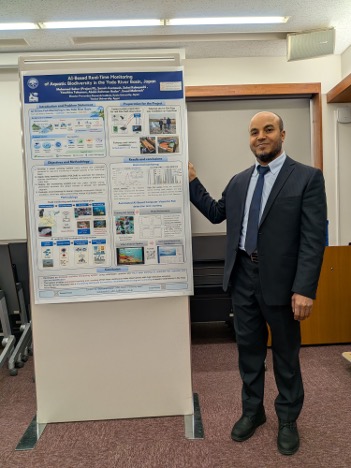
Mohamed Saber
Associate Professor (Specific Program)
Disaster Prevention Research Institute (DPRI), Kyoto University, Japan
Mohamed Saber, Ph.D., is an Associate Professor (Specific Program) at the Water Resources Research Center, Disaster Prevention Research Institute (DPRI), Kyoto University, Japan. His expertise lies in hydrological research and disaster risk management, with a strong focus on integrating artificial intelligence, including machine learning and deep learning, into hydrological applications to improve forecasting accuracy for floods, suspended sediment concentration, and rainfall.
His work includes the development of advanced hydrological models for wadi flash flood prediction and management, analysis of extreme climate variability and its implications for water resources, floods, and droughts, and the application of remote sensing technologies for hydrological monitoring. His research also extends to flood risk assessment, mitigation planning for vulnerable regions, and sustainable water resources management under climate change. Through his academic leadership and interdisciplinary collaborations, he contributes to strengthening hydrological resilience, disaster preparedness, and global water sustainability.