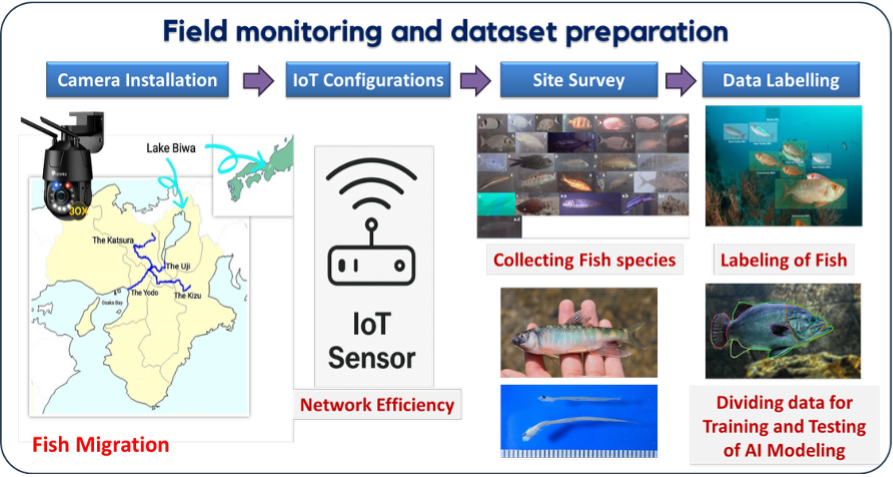
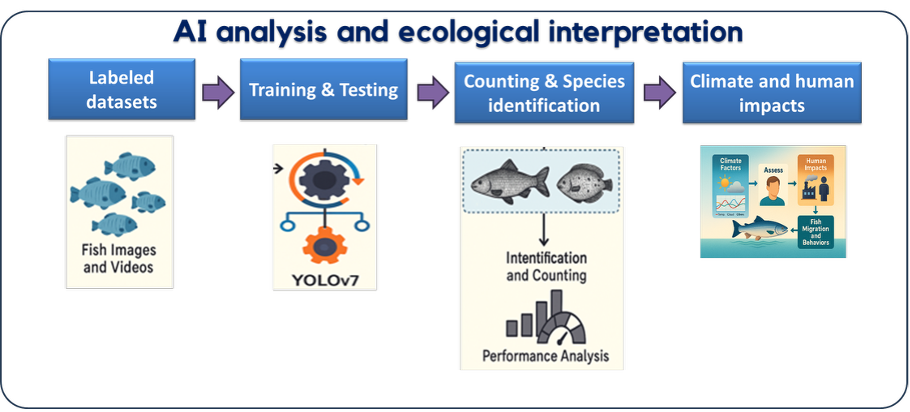
AI Development & Model Performance
Deep Learning Model & Training Pipeline
At the core of AquaTRAC AI lies the YOLOv8 (You Only Look Once, Version 8) object detection framework—selected for its optimal balance between high detection accuracy and real-time processing capability, making it ideal for continuous environmental monitoring and edge deployment.
AI Training Pipeline
Our model development follows a structured and adaptive training workflow:
-
Model Configuration and Optimization
The YOLOv8 architecture is carefully customized to address the unique challenges of aquatic environments, including:- Variable water clarity and turbidity
- Complex and dynamic backgrounds
- Low-visibility and low-contrast conditions
-
Initial Training (River-Specific Learning)
The model is first trained using curated datasets from the Yodo River Basin, enabling:- Accurate identification of local fish species
- Adaptation to site-specific environmental characteristics
- High precision in controlled ecological conditions
-
Future Enhancement (River–Sea Transfer Learning)
To further improve model robustness and generalization:- Training datasets from marine environments (e.g., collaborative datasets from Kobe University partners) will be incorporated
- Cross-domain learning will be applied to enhance feature extraction capabilities
- The model will then be fine-tuned back to river datasets, improving performance under diverse and unseen conditions
This hybrid strategy ensures the development of a scalable and transferable AI model, capable of deployment across different aquatic ecosystems.
Training Results & Model Evaluation
The initial training phase using localized Yodo River datasets has yielded highly promising and scientifically robust results, demonstrating the effectiveness of the AquaTRAC AI framework.
Key Performance Indicators
-
Model Loss (Training & Validation)
Both training and validation loss curves exhibit a consistent and stable decrease, indicating:- Efficient model convergence
- Strong generalization to unseen data
- Minimal overfitting
-
Classification Accuracy
- Top-1 Accuracy: Exceeding 99%, reflecting extremely high precision in identifying the correct species
- Top-5 Accuracy: Reaching 100%, ensuring reliable performance even in complex or ambiguous cases
-
Confusion Matrix Analysis
Evaluation results show:- High confidence across all target species classes
- Minimal misclassification, including among visually similar species
- Strong class separation and model reliability
Performance Significance
These results confirm that AquaTRAC AI can deliver high-precision, real-time detection and classification under realistic environmental conditions. The model’s strong performance provides a solid foundation for:
- Scaling to larger datasets and extended deployment areas
- Integrating behavioral and ecological analytics
- Supporting decision-making in biodiversity conservation and river management